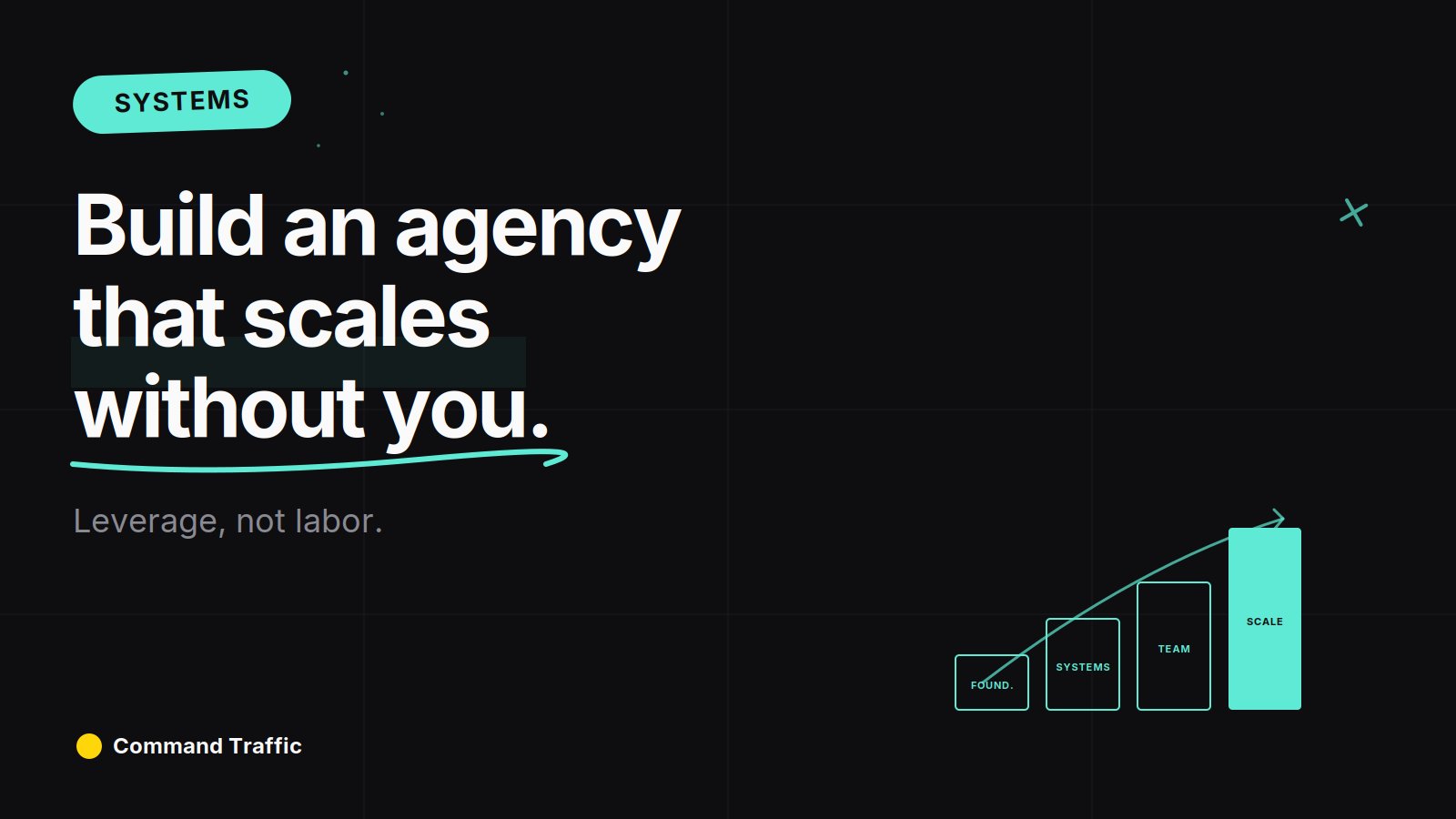
Most agency owners start the same way: no team, no infrastructure, no real systems. Just time, a marketable skill, and pressure to make something work. In that phase, the wrong decisions don’t feel wrong yet. Everything feels like progress because everything is new.
A sustainable agency model isn’t about what sounds impressive or trendy. It’s about whether the business can survive the moment demand shows up. If the model doesn’t scale cleanly while you’re still solo, it will collapse the second you try to grow.
The Leverage Problem
Every agency model is constrained by one reality: your time. If client fulfillment eats most of your week, you don’t have an agency — you have a job with overhead.
The only models that survive are the ones where time spent per client stays low while perceived value stays high. Most people misjudge what “scalable” actually means. If client fulfillment only requires a small number of hours per week, a single operator can support far more revenue than most people realize.
Compare that to models where fulfillment is tied directly to production. If each deliverable takes hours to create and clients expect constant output, growth doesn’t increase profit — it increases stress. Every new client forces a hire. Margins compress. Quality drops. The business becomes fragile instead of stronger.
The Leverage Models That Actually Work
Once you see this distinction, the landscape narrows quickly. Some services naturally lend themselves to leverage. Others never do, no matter how hard you work.
Media buying is a clear example. The value connects directly to revenue, so clients don’t need convincing that it matters. While upfront setup requires skill, ongoing management isn’t meant to be constant obsession. Well-structured campaigns need time to stabilize. Real work happens in strategy, testing, and interpretation — not constant tinkering.
Client selection matters just as much. High-ticket service businesses value leads differently than ecommerce brands. One good lead can be worth thousands, which changes expectations entirely. These clients care about outcomes, not micromanagement. They don’t need daily updates. They need the system to work.
Where the Real Leverage Lives: Automation
But even this model isn’t the ceiling. Installing AI systems and automations pushes leverage even further because the work is front-loaded.
Most of the effort happens during setup. Once systems are live, they largely run themselves. Viktor is built exactly for this — an AI coworker that connects to 3,000+ tools and actually does the work: reports, dashboards, campaigns, code, anything that normally requires a human sitting in a tool and manually pushing buttons.
From the client’s perspective, the math is obvious. A few thousand monthly for systems that replace tens of thousands in payroll is an easy decision. From the operator’s perspective, it means recurring revenue tied to infrastructure instead of labor.
With Viktor in the mix, a solo agency can install automated reporting systems, prospecting workflows, campaign management, and data pipelines that run without daily babysitting. The upfront fee covers setup, ongoing retainers cover maintenance — which is occasional, not constant. This is the model that actually scales without breaking.
Try Viktor — the AI coworker for agencies →The Pattern
When you step back, the models that last all share the same characteristics: high perceived value, low ongoing time requirements, clean handoff points when it’s time to delegate. They let you start solo, stack retainers, and only add complexity after the economics already work.
That’s how real agencies are built. Not by grinding harder. Not by adding more services. But by choosing models where leverage is baked in from the start.