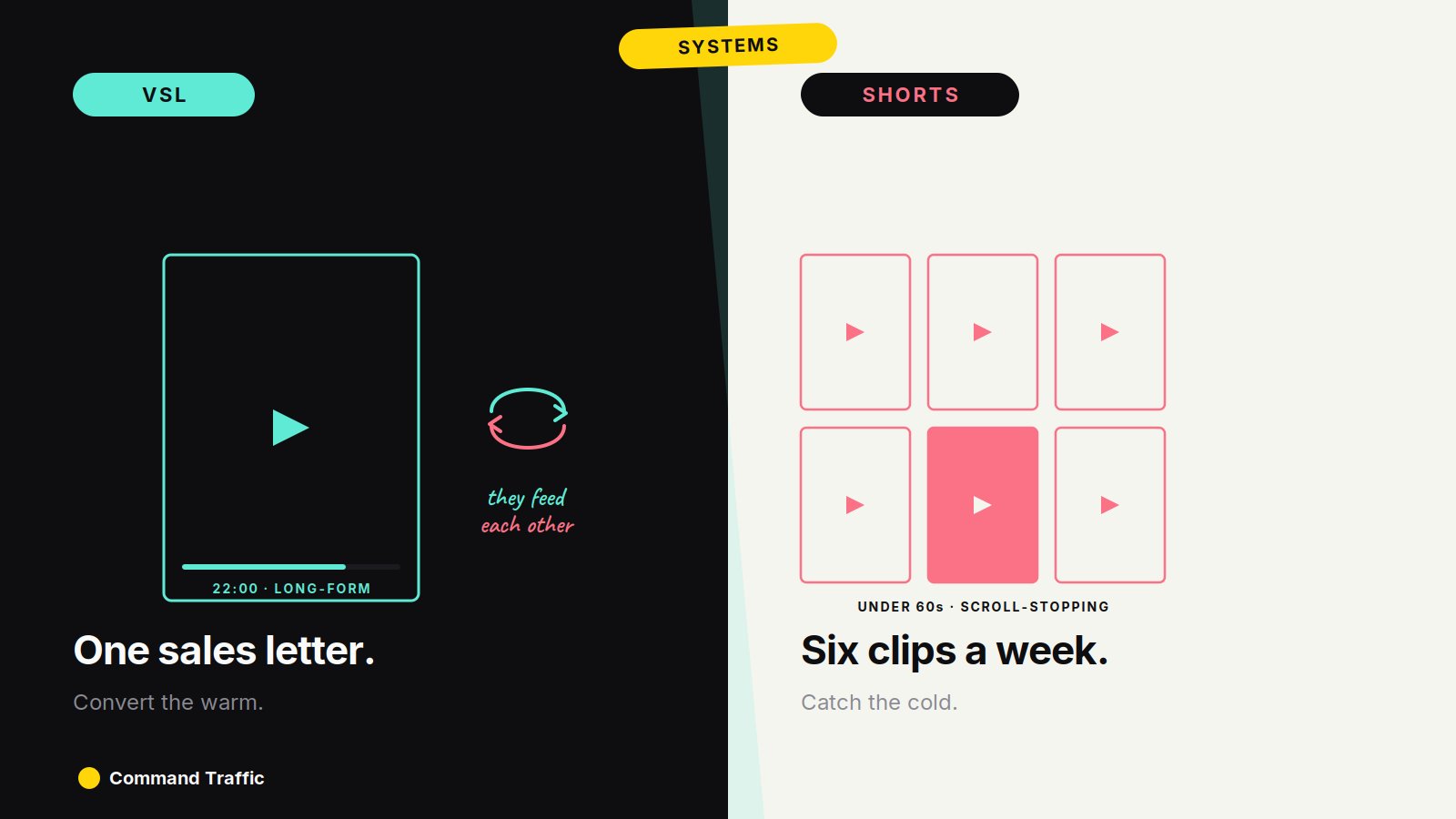
If you zoom out and look at who’s actually winning on YouTube right now, the pattern is obvious. It’s not entertainers, daily vloggers, or “YouTubers.” It’s marketers. Creators like Iman Gadzhi. Faceless channels printing cash. They all figured out the same thing — YouTube doesn’t reward effort, it rewards watch time on assets that convert. And the most powerful asset you can hand the algorithm is a VSL.
Here’s the full system — what to make, where to host it, how to feed it traffic, and how to turn one video into a sales machine that runs while you sleep.
Step 1: Build One Strong VSL
A VSL is just a long-form video that does one job. It explains an offer, builds demand, tells a story, and ends with a clear call to action. Think of it as a landing page in video form.
Most marketers hide their VSLs on private pages, locked behind opt-ins or only shown after an ad click. That’s the mistake. A VSL on a private page works once per visit. A VSL on YouTube works forever — and YouTube is the largest distribution engine on the internet.
Step 2: Prime the Algorithm With Clarity
Once your VSL is recorded, upload it as a public long-form video. Then make it impossible for YouTube to misunderstand it.
You need a keyword-rich description, clear niche language, multiple CTAs and links in the description, and relevant tags and search terms. Most people write this metadata as an afterthought, which is why their videos never get pushed — YouTube literally doesn’t know who to show them to.
LoudAF handles this end-to-end. Drop the VSL transcript into LoudAF and it generates the SEO description, the keyword tags, the chapter timestamps, and the metadata package optimized for the niche you’re targeting. It’s the difference between uploading a video and uploading a video YouTube actually understands.
Step 3: Feed the VSL With Shorts
This is where most marketers break the system. They post Shorts. But they don’t connect them.
Every Short you upload should act as a feeder for the same long-form VSL. When someone watches your Short, YouTube prompts: “Here’s a longer video you might like” — and now your VSL is sitting directly inside the Shorts feed, the highest-attention real estate on the platform.
The problem is producing enough Shorts to make the loop work. Manually clipping from your VSL is slow, and filming new Shorts daily is the kind of thing that breaks the system within a week.
Opusclip is the tool built specifically for this. You drop in a long-form YouTube video — your VSL, a podcast, a webinar, anything — and Opusclip uses AI to identify the most viral-worthy moments, cut them into Shorts, add captions, and reformat them for vertical viewing. One VSL becomes 10 to 30 Shorts automatically.
Step 4: Stay Faceless When You Need More Volume
Sometimes the AI clips from your VSL aren’t enough — you want fresh Shorts on adjacent topics, fresh hooks, fresh angles to keep the feeder layer working at scale. And not every Short needs to feature you on camera.
Syllaby is built for fast, faceless viral content — script, voiceover, visuals, captions, the whole production handled automatically. You feed it the topic and it produces a finished Short you can post the same day, all without filming a frame yourself.
Step 5: Traffic Creates Trust
Here’s why this loop works so hard once it’s running.
The more Shorts you post, the more people hit your VSL. The more people hit your VSL, the longer they watch. The longer they watch, the more YouTube trusts the video. And once YouTube trusts it, the platform starts distributing it on its own — search results, suggested videos, recommended feeds, end-screen recommendations on other creators’ content.
Step 6: Don’t Stop at YouTube
Now take that same VSL link and put it everywhere external. Instagram bio. TikTok bio. X bio. Email signature. Blog posts. Funnels. Every external click tells YouTube the same thing: “This video matters.”
The manual version of this is exhausting — uploading the same Shorts to TikTok, Instagram Reels, Facebook, Pinterest, and X means re-cutting, re-captioning, re-uploading every time. Repurpose.io automates the whole thing. Post a Short to one platform, and Repurpose grabs it and auto-publishes everywhere else. One upload becomes seven posts, every time, with no manual work.
This is what closes the loop. Shorts feed the VSL on YouTube. Repurpose pushes the same Shorts to every other platform. Every platform sends traffic back to the same VSL. The asset accumulates trust signals from everywhere at once.
Step 7: Make Sure the VSL Actually Sells
Here’s the part most marketers ignore until it’s too late. The VSL itself only matters if the click leads somewhere that converts.
If your VSL ends with “click the link in the description” and the link points to a thrown-together page, you’re leaking the entire system’s output. The whole point of the loop is to drive traffic to a sales asset — and the destination matters as much as the traffic.
BuildWithOS handles the conversion side end-to-end. The landing page, the checkout, the email follow-up, the upsell flow, the retargeting — all from one dashboard. The VSL is the salesperson. BuildWithOS is the cash register.
Build your VSL funnel with BuildWithOS →The Rule Most People Miss
Here’s the part of the system that matters more than any tool.
You don’t need to be entertaining. You don’t need fancy edits. You don’t need to be a “YouTuber.”
You need one strong VSL, SEO that gives it clarity, Shorts that feed it attention, and traffic that reinforces importance. That’s it. Do this consistently and YouTube becomes an unpaid salesperson — working 24/7, pushing the same offer, building demand while you do nothing.
The Full YouTube VSL Loop Stack
Five tools, mapped to the parts of the loop:
Build this once and one VSL becomes a month of content, distributed everywhere, all routing back to a system that sells.
Frequently Asked Questions
How long should my VSL be? Anywhere from 15 to 45 minutes works. Longer VSLs generate more watch time per view, which YouTube rewards heavily — but they need to be paced well or viewers drop off. Length isn’t the metric. Retention is.
Do I need to record on camera or can the VSL be faceless? Both work. On-camera VSLs build more trust and convert harder for higher-ticket offers. Faceless VSLs scale faster and work fine for digital products and lower-ticket offers. Syllaby handles the faceless side end-to-end.
How many Shorts should I post per day? Three to five Shorts daily is the working minimum. Once Opusclip is producing them automatically, hitting that volume takes minutes, not hours.
Will YouTube penalize me for cross-posting? No. Each platform’s algorithm cares about engagement on its own platform, not whether the video lives elsewhere. Repurpose.io handles the format adjustments so each version looks native.
Final Word
YouTube isn’t a content platform anymore. It’s a distribution engine for assets that convert. The marketers winning right now aren’t entertainers — they’re operators who figured out that one well-built VSL plus a feeder loop is worth more than a hundred random uploads.
Build the VSL. Feed it Shorts. Push every link back to it. Let the algorithm do the rest.
See more tools →