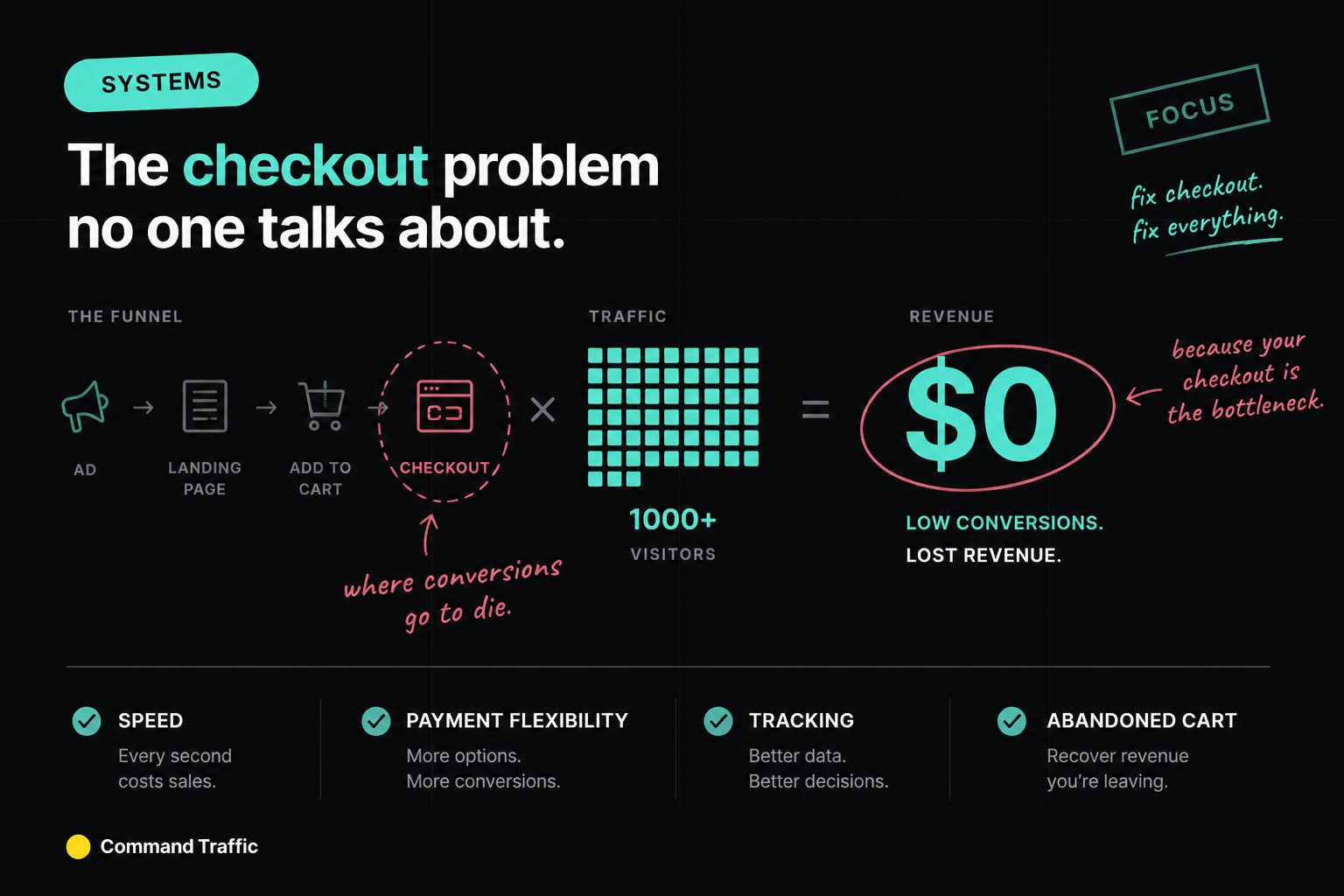
For the longest time, SamCart was my checkout. And for good reason — it was genuinely the best option for a long time.
Why SamCart Was The Best (For Years)
Compared to everything else available — ClickFunnels, GoHighLevel, Shopify checkout, custom builds — SamCart was the easiest to use as a non-technical person with zero coding ability. You could set up a product, build a checkout page, and be live in minutes.
But the real advantage was what it offered out of the box. One-click Meta Pixel integration. One-click Google Analytics. And the big one — multiple payment options. PayPal, Klarna, card — all without custom coding or developer work. At a time when most platforms forced you into card-only checkout or required a developer to add PayPal, SamCart just had it built in.
That alone was a massive conversion advantage. Offering PayPal as a payment option probably added 15-20% more buyers who wouldn't have purchased otherwise. People trust PayPal. People already have money in PayPal. Removing that friction was worth more than most landing page optimizations ever were.
Then Something Changed
SamCart took on a big investment and used it to rebuild the platform. New interface. New features. New everything. And ever since that change, conversions got worse.
Not dramatically at first. But I started noticing a pattern. Checkout views were there. People were clicking buy. But they weren't finishing. The completion rate was off.
Then I actually found a bug where the checkout form wouldn't submit properly. Like, literally wouldn't work. I brought it to SamCart's attention and their response was basically: "Wow, thanks for catching this — this is crazy."
That shook my confidence. But I carried on. Figured it was a one-time thing. Fixed now. Move on.
Still, something felt off.
The $500 Offer Problem
Here's the thing — I'd started selling $500+ offers to cold traffic. These offers take consideration. It's not unusual for people to visit checkout and bounce because they're circling, debating their decision, checking their bank account, asking their partner. That's normal for high-ticket cold traffic.
So the low checkout conversion stats didn't worry me too much at first. I told myself this was just the nature of the product and the audience.
But it was still unusually low. My gut said something was wrong. I just couldn't prove it yet.
Testing Stripe Payment Links
First thing I tried was Stripe Payment Links. Because it's so damn easy. Generate a link, paste it on your page, done.
But immediately the problems showed up. No analytics. No Meta ads tracking. No abandoned cart info. No way to see who started checkout and didn't finish. You're flying blind.
Still, I figured — at least checkout should be faster and cleaner. So conversion should improve just from reducing friction. Right?
Nothing changed.
But Something Was Still Wrong
Those low conversion rates kept eating at me. Way too many people hitting checkout and not buying. So I started testing the page myself — actually going through the checkout flow as a customer.
And I noticed two things immediately.
First: it was loading slow. Not catastrophically. But noticeably. That half-second delay where you're staring at a loading spinner right at the moment of purchase decision? That kills momentum.
Second: it was crowded with payment options. Like a buffet. Card, PayPal, Klarna, Apple Pay, Google Pay, Link, whatever else — all stacked on top of each other in this wall of choices. You click one option and a whole new module pops up. Or the default Link pay auto-expands before you even asked for it.
The checkout form should be static and easy. Not some monster wall of options right at the moment someone is trying to give you money. Too many choices creates hesitation. And hesitation at checkout is the most expensive kind.
Then SamCart Changed Their Pricing
On top of everything else, SamCart recently switched to a revenue-share model. The more you make, the more they take — on top of a monthly subscription around $200.
Looking For Something That Just Works
I started looking around again. And immediately crossed off the usual suspects.
ClickFunnels? No. Overbuilt, expensive, and I don't need an entire funnel builder just to accept a payment.
GoHighLevel? Clunky and expensive. Great for agencies, overkill for a checkout page.
All I needed was simple: a link I can add to any website that brings people to checkout, tracks purchases, has abandoned cart features, and integrates with Google Analytics and Meta. That's it. Nothing complicated. No ecosystem. No app store. No theme builder. Just checkout.
Then I Found PurpleTurret
And that was exactly what I needed.
PurpleTurret is a lightweight checkout platform built for exactly this use case. Simple setup. Clean checkout experience. Perfect tracking and integrations. No bloat.
I plugged it in. Same offer. Same price. Same traffic.
The purchases reported right back into my Meta ads account. Everything was flawless. Attribution was clean. I could actually see what was working. The ad account started optimizing properly because it was finally getting clean purchase data.
No more guessing. No more duct-taping tracking together. No more wondering if checkout was the bottleneck.
It was. And now it's not.
Check Your Checkout
If your ads are working, your page is converting, people are clicking buy — and they're still not finishing the purchase — stop rewriting your offer. Stop blaming Meta. Stop changing your price.
Look at your checkout.
Is it fast? Is it simple? Is it clean on mobile? Or is it some overbuilt monster with seventeen payment options, slow load times, and tracking that doesn't report back properly?
The moment I stopped overcomplicating checkout and switched to something simple that just works, everything changed. Not just conversion rates — my entire ability to scale, because I could finally trust the data.
If you haven't looked at your checkout completion rate recently, go look. Right now. Because it might be the most expensive leak in your entire business.
Try PurpleTurret → See more tools →