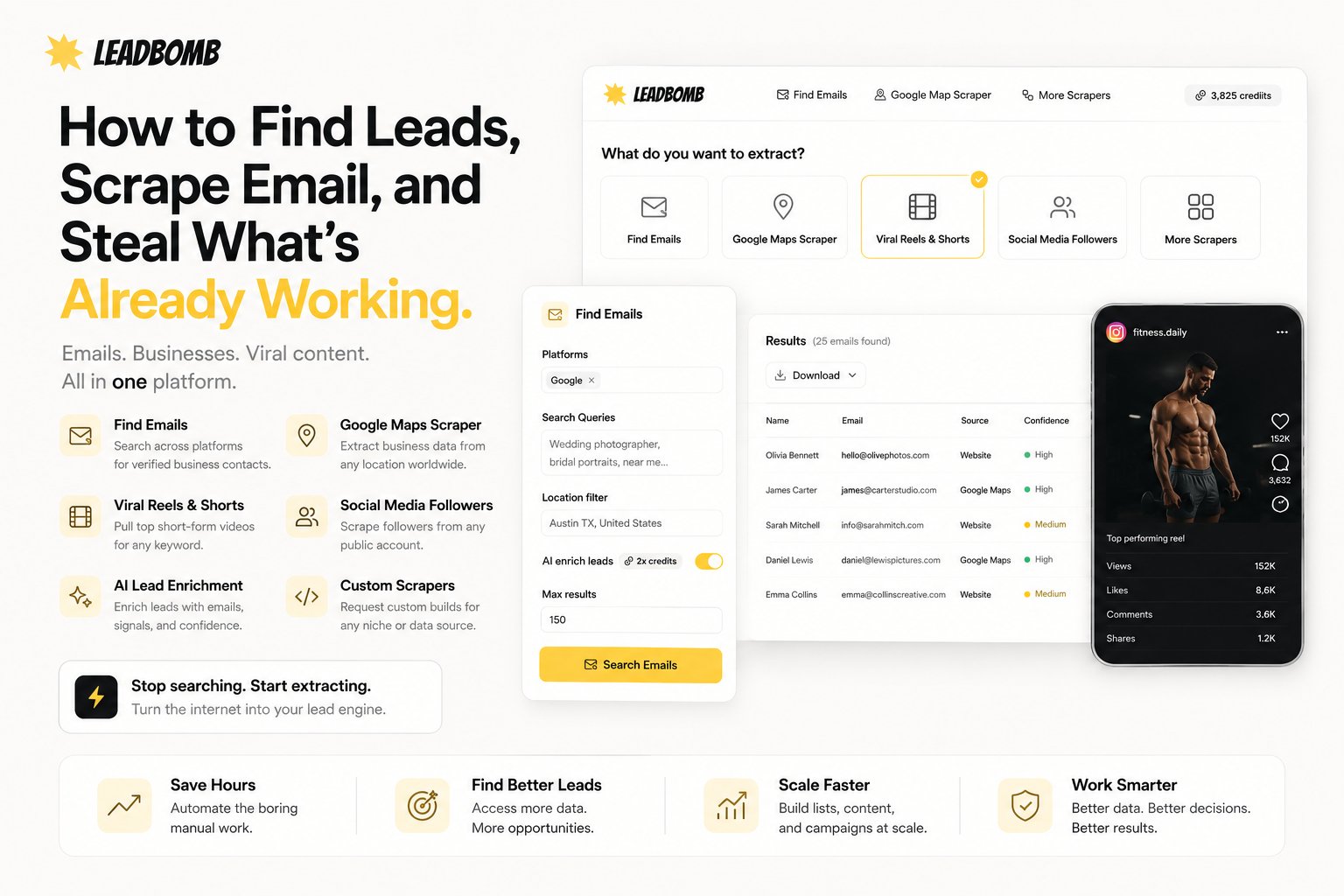
Most people think lead generation still looks like this: open Google, search manually, open profiles, copy emails, build spreadsheets, send messages, repeat until your soul leaves your body.
That worked. For a while. But now there's a new category of tools showing up that basically turns the internet into a searchable database.
And one of the cooler examples I've been testing lately is LeadBomb.
At first glance it looks like an email scraper. That's what most people use it for. But once you actually start clicking around, you realize it's way bigger than that.
Most People Start With Email Scraping
This is the obvious use case. You want leads. You don't want to manually find them. Inside LeadBomb you can search across platforms and pull verified contact information tied to public business profiles.
You define platforms, keywords, locations, filters — and let the system work. Real estate agents, dentists, wedding photographers, AI agencies, gym owners, roofing companies, local restaurants. Then export the results. Simple.
Search Multiple Platforms At Once
One thing I liked immediately is the flexibility. You're not locked into one source. You can search across different platforms and combine data.
Because the internet already contains most of the information. The bottleneck is retrieval.
Google Maps Is Quietly One Of The Best Lead Databases
This feature is way more powerful than people realize. Most people think Google Maps is navigation. Marketers see a giant business directory.
With LeadBomb you can search categories and pull business data at scale. Coffee shops, med spas, gyms, agencies, lawyers, roofers, restaurants, local service businesses. Add a location. Run extraction. Build lists.
AI Lead Enrichment
This is where things start becoming less scraper and more workflow. Instead of only returning raw results, you can enrich leads. The system checks sources and tries to produce more usable lead information — profile data, company context, contact information, confidence signals.
That sounds small. But enrichment is usually where manual work explodes. So compressing that step matters.
Viral Reels Scraping Is Sneakily One Of My Favorite Features
This was unexpected. Most people will completely miss this section. But there's a scraper specifically for viral reels and short-form content.
That opens a completely different use case. Instead of using the platform for outbound, you can use it for content.
Search fitness, AI tools, marketing, luxury homes, motivation — pull top-performing short-form content. Study patterns. Build inspiration libraries. Analyze formats.
Social Media Followers Scraping
This one is interesting for creators. You can pull followers tied to public accounts. Which means you can start studying audiences, overlap, competitors, creators, and communities.
Not necessarily for outreach. Sometimes just understanding where attention already exists. This becomes useful for influencer research, niche analysis, audience mapping, and campaign planning.
Custom Scrapers Are The Hidden Weapon
This section caught my attention. Because eventually everyone hits this moment: "I wish I could scrape THIS specific thing." That's where custom builds come in. Instead of hoping the platform supports your exact workflow, you can request custom retrieval systems.
The Bigger Shift Happening Here
I think tools like this point to a bigger trend. The internet is becoming queryable.
Old way: Search → click → search → click → copy → organize.
New way: Define → extract → enrich → export.
That changes speed dramatically. And speed compounds.
Who This Is Actually Good For
After playing around with it, I think LeadBomb makes the most sense for agencies, local lead gen, cold email, appointment setters, SaaS outreach, creators, affiliate marketers, niche page builders, content researchers, and outbound operators. Especially if you repeatedly find yourself doing internet detective work.
My Favorite Mental Model
Don't think of this as "an email scraper." Think of it more like a search engine for opportunities. Sometimes opportunities look like emails. Sometimes businesses. Sometimes viral content. Sometimes audiences. Same concept. Different output.
Final Thoughts
Most people use maybe 5% of tools like this. They find one feature. Stick with it. But platforms like LeadBomb get interesting when you zoom out.
You can find emails, scrape businesses, enrich leads, analyze viral content, study audiences, build prospect lists, and export workflows.
