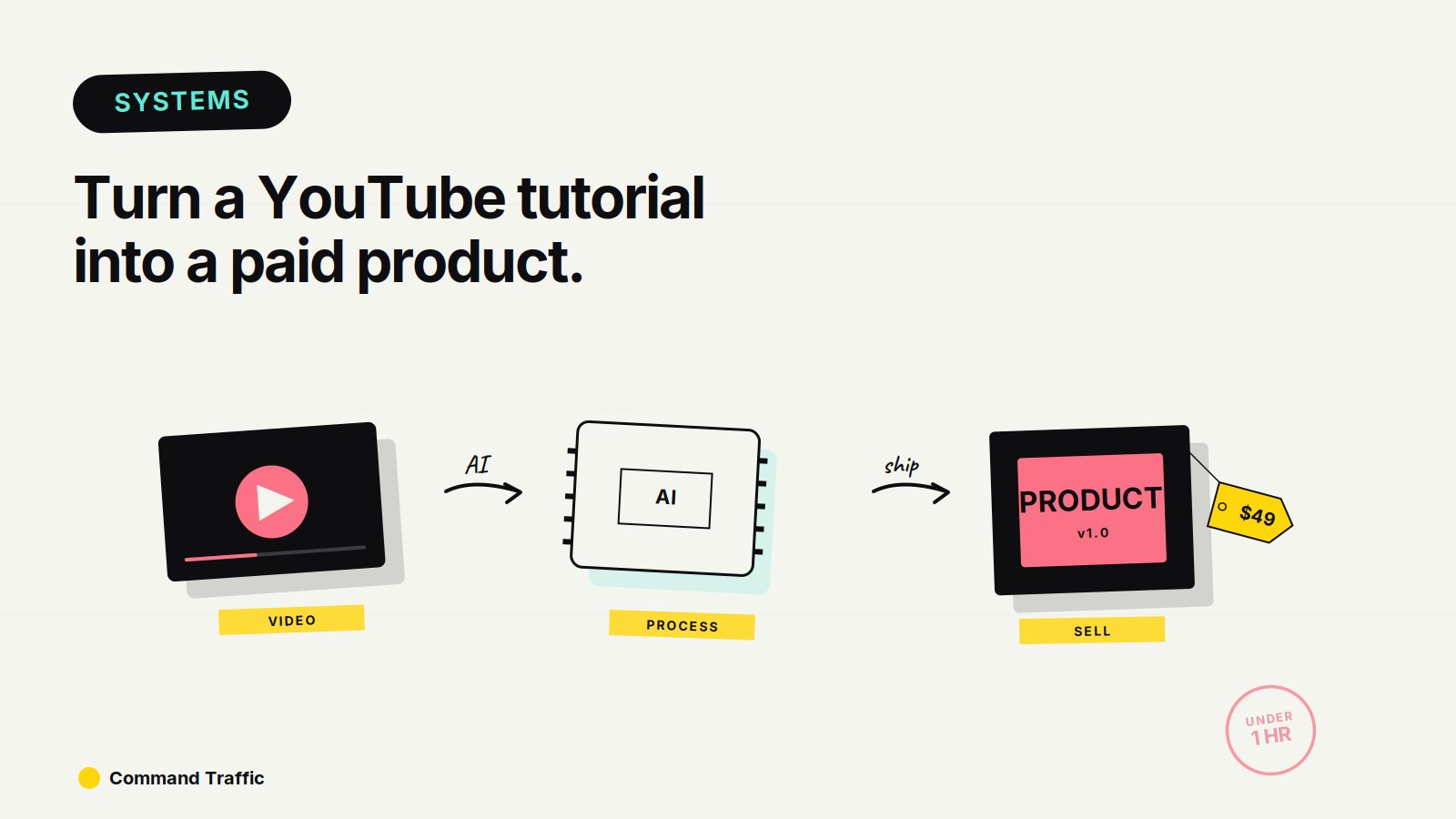
You can turn almost any tutorial-style YouTube video into a sellable digital product in under an hour. No research phase, no blank page, no complicated setup. You start with a video that already teaches something well — long-form tutorials, breakdowns, deep explanations — and AI handles the conversion from raw video into a clean, structured guide.
The hard part used to be production. Now it’s about ten minutes of work. The advantage has shifted somewhere else entirely.
Here’s the full system — how to convert the video, where the real leverage hides, and how to actually sell what you build.
Step 1: Pick a Video Worth Packaging
Not every video is product material. The ones that work share a few patterns: they teach a complete process from start to finish, they include enough detail that the viewer can act on it, and they cover a topic where there’s genuine demand for someone to clean up the noise.
Long-form tutorials, framework breakdowns, and step-by-step walkthroughs are the highest-yield source material. A 45-minute YouTube video on something like “how to run paid ads on a $500 budget” contains more usable content than most paid courses sell — it just isn’t packaged in a way anyone would pay for.
Step 2: Convert the Video Into Structured Content
The traditional move is to paste the YouTube URL into ChatGPT and ask it to generate a guide. That works, but it’s the slow version of the workflow and the output usually needs a lot of cleanup before it’s sellable.
LoudAF’s Article Engine is built specifically for this conversion. You drop in a YouTube URL, RSS feed, or raw notes, and LoudAF produces SEO-ready, structured content with clean sections, real flow, and your voice baked in. What takes 30 minutes of prompt-and-edit work in ChatGPT takes about 90 seconds in LoudAF, and the output lands closer to publishable on the first pass.
In minutes, you have a usable foundation — sections, examples, action steps, a clean structure. That part is easy now.
And that’s exactly the problem.
Step 3: Decide What Actually Matters (This Is the Real Product)
Most people stop at the foundation. They export the AI output, design a PDF around it, list it for sale, and wonder why nobody buys. The method isn’t wrong. The mistake is thinking the method is the product.
A sellable product isn’t “a guide from a video.” It’s a series of decisions:
That judgment is the product. The video is just raw material. The AI output is just the first draft. The reason your version is worth paying for — when the original video is free — is that you did the sorting the viewer would have had to do themselves.
Step 4: Put It Where It Can Actually Sell
Here’s where most people get stuck. They’ve made the product. They’ve done the editing. They’ve designed the PDF. Now they need to actually sell it — and selling a digital product means a checkout page, a delivery system, an email sequence, and ideally a back-end that does follow-up automatically. Without that, you have a finished PDF sitting on your hard drive.
BuildWithOS handles the entire sales infrastructure in one place. The landing page, the checkout, the automatic delivery, the email follow-up sequence, the upsell flow — all from one dashboard, no developer required. You can have a product live and selling within an afternoon of finishing the content.
The reason this matters more than people realize is that the first product is the hardest to ship. Once the infrastructure is built once, every future product takes hours instead of weeks, because BuildWithOS lets you clone the whole funnel and swap the content. The leverage compounds across products, not just within one.
Build your product funnel with BuildWithOS →Step 5: Repeat the System on the Right Videos
Once the workflow is dialed in — find video, run through LoudAF, apply judgment, ship through BuildWithOS — the bottleneck stops being production and becomes selection. Which videos are worth packaging? Which audiences are underserved? Which topics have buyers who’d pay for clarity?
This is the question that separates people who make one product and stop from people who turn this into a real catalog. It’s also the question you actually have leverage on, because the system runs in under an hour either way. The difference between one $5K month and a $50K month isn’t the speed of the workflow. It’s the quality of what you decided to package.
The Rule Most People Miss
Here’s the part of the system that matters more than any tool.
Most creators ask, “How do I make more products?” The better question is, “What’s actually worth packaging?” The first question leads to a folder full of unsold PDFs. The second leads to a small number of products that sell consistently because someone — you — actually decided what mattered before publishing.
People don’t buy information. They buy clarity. They buy someone else doing the sorting. If you can take scattered knowledge and turn it into something focused, you can sell it. If you can’t, you’re just publishing documents.
LoudAF handles the structuring. BuildWithOS handles the selling. Your judgment fills the gap between them, and that gap is where the entire business lives.
The Full Digital Product Stack
Two tools run almost the entire workflow:
Set this up once and every future digital product takes hours from idea to live, instead of weeks.
Frequently Asked Questions
Is it legal to turn someone else’s YouTube video into a paid product? You can’t copy the video itself or reproduce it word-for-word, but you can absolutely use the information — frameworks, methods, ideas — as the basis for original work in your own words. The judgment and packaging is your contribution, and it’s what makes the product yours.
What kinds of videos work best as source material? Tutorial-style videos with concrete frameworks, step-by-step processes, or specific methods. Avoid pure entertainment, opinion content, or videos without a clear teachable structure — there’s nothing to package.
How much should I charge? Products in the $27–$97 range tend to convert best for this format. The price isn’t tied to the production cost — it’s tied to how much time and confusion you’re saving the buyer.
Can I make multiple products from the same video? Yes, and you should. A 60-minute tutorial often contains material for a quick guide, a deeper breakdown, a checklist, and a template — different formats serving different buyer intents. LoudAF makes producing the variations almost free.
Final Word
The hard part of selling digital products used to be making them. That’s solved. The hard part now is deciding what to make and what to leave out — and the people who win at this aren’t the ones with the most products. They’re the ones with the clearest judgment about what’s worth charging for.
The system above takes care of everything except the judgment. That part is still yours to bring.
See more tools →